
Efficient and Safe Shorelines and Banks Mowing: How to Tackle Steep Slopes, Brush, and Vines with SPIDER
Maintaining vegetation along shorelines and embankments isn’t like mowing a flat lawn. In the U.S., crews are responsible for keeping pond dams, lake edges, riverbanks, levees, stormwater retention/ detention basins, drainage channels, and canal banks under control — often on steep slopes, uneven ground, and hard‑to‑access terrain.

Maintaining steep slopes, pond banks, lake edges, and stormwater retention areas is one of the most challenging and hazardous tasks in landscape management.
Traditional methods using manned machines on dangerous terrain put operators at serious risk. SPIDER Remote‑Controlled Mowers deliver a safer way forward—combining maximum operator safety, superior efficiency, and cutting‑edge slope‑mowing technology designed specifically for shoreline and bank work.
When you add woody brush and volunteer saplings, invasive vines, thick seasonal growth, and wet or unstable soils, conventional mowers and tractors quickly become slow, risky, and costly. That’s where remote‑controlled slope mowingchanges the game—keeping crews off the slope, maintaining clear inspection sightlines for stormwater assets, and delivering a clean, consistent cut on steep, saturated banks where other machines struggle.
Why Shoreline & Bank Mowing Is So Challenging (And Why Standard Equipment Often Falls Short)
1) Steep slopes + uneven ground = high risk and low speed
Banks and embankments are rarely uniform. You’ll encounter:
Sudden grade changes
Rutting and washouts
Rocks, debris, and hidden obstacles
Narrow access routes along dams and berms
On steep terrain, conventional ride-on mowers and tractors often require slower passes and wider safety margins—reducing productivity.
2) Wet edges and soft soils can destroy traction (and the jobsite)
Even when the top of a bank looks dry, moisture can sit below the surface near the waterline. This can lead to:
Wheel slip and turf damage
Ruts that accelerate erosion
Getting equipment stuck and needing recovery
3) Vegetation isn’t “just grass” on banks
Many shoreline sites deal with aggressive growth cycles and mixed vegetation such as:
Volunteer saplings (unwanted woody growth)
Brush and thick weeds
Climbing vines and ground-covering vines
Dense seasonal growth after rain events
If you’re maintaining stormwater basins, ditches, or riverbanks, you know the pattern: miss a window and the next pass becomes a heavy-duty clearing job.
4) Access limitations increase labor costs
A lot of shoreline mowing is hard-to-access mowing:
Narrow tops of pond dams
Restricted access in subdivisions or parks
Limited turning radius along levees
No safe way to put an operator directly on the slope
That often pushes crews toward labor-heavy options like trimmers and brush cutters—or slow, risky approaches with machines that weren’t designed for steep work.

The Hidden Costs of “Making Do” With the Wrong Mower
Even if you can technically mow a bank with general equipment, the real cost shows up as:
Longer job times (slow passes, multiple approaches)
Higher labor exposure (more time in risky zones)
Inconsistent results (missed patches, uneven cut, regrowth)
Ground damage (ruts and scarring on soft embankments)
Repeat visits due to inadequate clearing of vines/woody growth
Professional bank mowing with SPIDER mowers is about reducing total cost per acre (or per site) while keeping crews safer.
Who Bank Vegetation Management Is For
This type of mowing work is common across both public and private sectors.
-> Municipalities & County Public Works
Stormwater pond maintenance (retention/detention basins)
Park ponds and lakefront areas
Drainage channels and easements
Pain point: limited crews, time windows, and safety concerns.
Why they buy:To keep stormwater assets inspection‑ready with small crews and tight windows while keeping operators out of roll‑over zones.
-> Stormwater & Environmental Contractors
Vegetation management in basins and along channels
Routine mowing plus heavy overgrowth cleanup
Pain point: fluctuating conditions, high growth rates, tough access.
Why they buy: To safely take on steep, wet, overgrown sites faster and more profitably, winning bids without adding labor risk.
-> Pond, Lake, and HOA Property Managers
Community stormwater ponds
Decorative lakes and shoreline areas
Berms, banks, and dam faces
Pain point: appearance + liability + consistent maintenance.
Why they buy: To protect curb appeal and compliance while reducing liability by keeping crews off hazardous shorelines.
-> Levee, Canal, and Flood-Control Operators
Levee mowing and inspection visibility
Canal banks and drainage networks
Pain point: keeping slopes clear for inspection and access.
Why they buy: To maintain clear sightlines and erosion control on long, saturated embankments and improve inspection access.
-> Land Management & Vegetation Management Companies
Mixed portfolios of steep slopes and difficult terrain
Pain point: need an all-around solution that increases throughput.
Why they buy: To use one platform that boosts crew throughput across diverse steep, wet terrains and cuts manual trimming.
The Modern Solution: Remote-Controlled Slope Mowing Near Water
When slopes get steep and access gets tight, remote-controlled slope mowers help solve two of the biggest issues at once:
Operator safety: the operator can remain at a safer position rather than standing on the slope.
Productivity: designed for steep terrain, these machines maintain stability and consistent cutting—especially on embankments and banks.

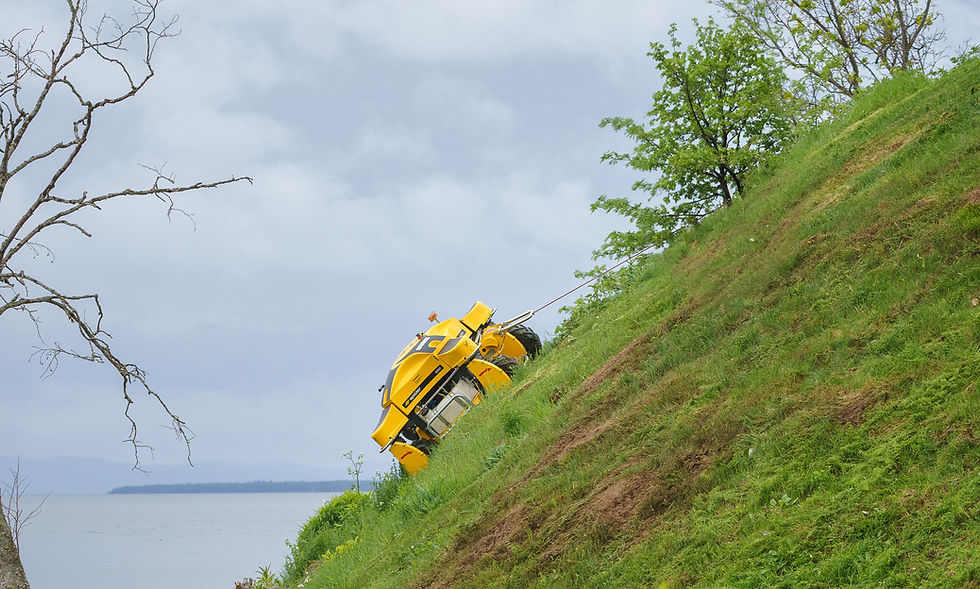
Safe Maintenance of Steep Banks Using Remote‑Controlled SPIDER Mowers
A remote‑controlled slope mower keeps the operator off the hazard zone, reducing exposure to roll‑over risks, hidden ruts, flying debris, and heat stress common with ride‑on equipment and manual brush cutting. With a control range up to 900 feet, crews can mow steep hillsides, deep brush, and uneven banks from a safe position. SPIDER adds further protection with a hydraulic stabilizing winch that keeps all four wheels planted on extreme slopes, while safety features such as an emergency stop (shuts down engine and blades within seconds) and automatic wheel lock on power loss help prevent runaways on inclines; as a best practice, SPIDER recommends line‑of‑sight operation, typically within ~165 feet.
In shoreline applications, this approach is especially valuable on:
Pond dams and earthen embankments
Stormwater retention/detention basin side slopes
Riverbanks and canal banks
Levee slopes and flood-control structures
SPIDER Mowers for Shoreline & Bank Mowing: Which Model Fits Your Work?
Below are two strong solutions for shoreline/riverbank mowing—each aimed at a slightly different workload.
SPIDER 2SGS EFI: The Heavy-Duty Answer for Tough Banks, Brush, and Vines
If your shoreline work includes aggressive vegetation, woody brush, and climbing vines, the SPIDER 2SGS EFI is the model positioned for the most demanding environments.
Best for:
Steep banks where traction and stability matter
Sites with woody volunteer growth (saplings)
Areas overrun by vines and tangled vegetation
Crews that need maximum capability and high throughput
Contractors who want a top-tier machine for varied, difficult sites
Why it stands out in bank mowing:
Built for slope performance (purpose-designed for steep terrain)
Remote operation helps keep the operator away from the hazard zone
Capable mindset: built for the jobs where lighter machines slow down or struggle
Learn more: SPIDER 2SGS EFI
SPIDER ILD01: High Performance for Everyday Bank Maintenance (Less Extreme Sites)
Not every customer needs the most aggressive configuration—especially if their work is mainly routine grass and standard bank upkeep with occasional heavier growth.
That’s where the SPIDER ILD01 fits: still efficient and strong, but better aligned for users who don’t face heavy brush and vine battles on every site.
Best for:
Routine mowing on pond banks, stormwater ponds, and embankments
Landscapers and maintenance crews with mixed terrain
Sites that are steep but not consistently overgrown with woody growth
Buyers who want high productivity without “max-duty” needs
Learn more: SPIDER ILD01
FAQ
How often should you mow shoreline banks and stormwater ponds?
Most crews aim for a schedule that prevents vegetation from turning into woody growth or vine mats. Frequency depends on rainfall, region, and growth rate—but consistency is key to keeping time and costs down.
What’s the safest way to mow steep pond dams and embankments?
The safest approach is minimizing operator exposure on steep slopes and working with equipment designed specifically for slope stability. Remote-controlled slope mowing can keep the operator in a safer position while the mower handles the bank.
Can shoreline mowing equipment handle vines and brush?
Some can, but not all. If your sites are frequently tangled with vines or include volunteer saplings, you’ll want a model positioned for heavy-duty vegetation challenges—like SPIDER 2SGS EFI.
What’s the best mower for stormwater retention/detention basin side slopes?
A purpose-built slope mower is typically a better match than standard lawn equipment because basin slopes can be steep, uneven, and difficult to access—especially after rain events.
Which SPIDER model is better for general bank maintenance?
For routine shoreline and embankment mowing that’s not consistently overgrown, SPIDER ILD01 is a strong fit. For tougher brush and vine pressure, SPIDER 2SGS EFI is the heavy-duty choice.
Conclusion: Turn Risky, Slow Shoreline Mowing Into a Repeatable Process
Shoreline and embankment mowing in the U.S. is often a blend of steep slopes, limited access, and aggressive vegetation. When crews rely on equipment not designed for these conditions, projects become slower, riskier, and more expensive than they need to be.
If your work involves demanding slopes and frequent encounters with brush and vines, SPIDER 2SGS EFI is positioned as the top-tier solution for high-capability slope mowing. If your workload is more routine—still steep, still serious, but not consistently extreme—SPIDER ILD01 delivers efficient, professional maintenance performance.
Ready to choose the right SPIDER for your shoreline work?
SPIDER 2SGS EFI (max capability)
SPIDER ILD01 (everyday pro performance)


Comments